
Used Forklift Financing
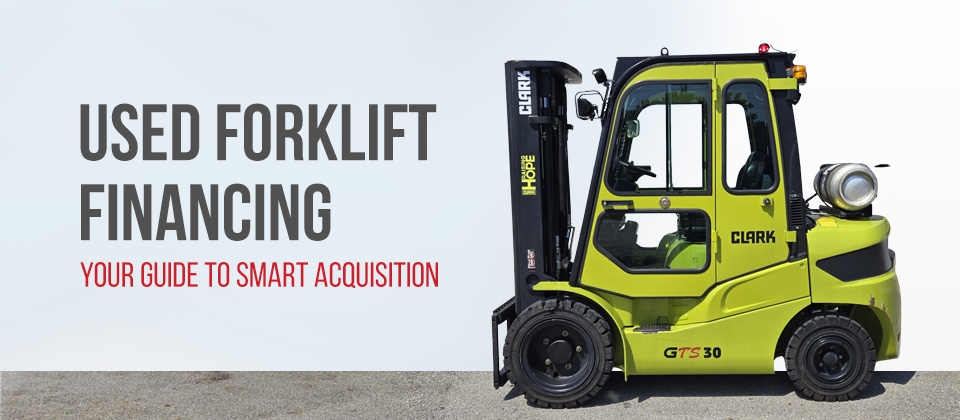
Used Forklift Financing — Your Guide to Smart Acquisition
Forklifts keep warehouses, distribution centers and jobsites running smoothly, but they’re also a significant capital expense. For many operations managers and procurement professionals, financing a used forklift offers the best of both worlds — reliable material handling equipment without the steep up-front cost of buying new.
You’ll make crucial decisions when financing a used forklift, from understanding the difference between leasing and buying to availing yourself of tax advantages. Whether you’re expanding your fleet or replacing aging equipment, financing preserves cash flow while meeting your operational needs.
New vs. Used Forklifts
Consider the advantages and drawbacks of new and used forklifts to choose the best options for your business.
Used |
New |
|---|---|
| Lower up-front costs | Higher initial costs |
| Better value retention | Full warranty coverage |
| Immediate availability | Latest features and technology |
| Lower insurance costs | Customization options |
Used Forklifts
In many cases, a used forklift with a comprehensive service history performs as well as a new model. These advantages make used equipment an attractive option for cost-conscious businesses.
- Lower cost: Used forklifts can cost significantly less than new models, making them more budget-friendly.
- Retained value: Used forklifts have already absorbed the steepest part of their depreciation curve. If you sell a few years down the line, the equipment will lose a smaller percentage of its remaining value.
- Immediate availability: New forklifts often require lead times for manufacturing and delivery, while used ones are available right away.
- Lower insurance costs: Insurers calculate premiums based on asset value. Since used forklifts carry lower market value, they cost less to insure against damage, theft or other risks.
New Forklifts
Most managers choose new forklifts for around-the-clock operations that demand maximum reliability. Consider the following factors.
- Higher initial costs: A brand-new forklift costs considerably more than a comparable used model.
- Full warranty coverage: New forklifts include comprehensive manufacturer warranties covering parts and labor for a specified period or operating hours.
- Latest features and technology: New forklifts incorporate current advancements in safety, efficiency and operator comfort.
- Customization options: You can specify the exact configuration of your forklift, including specialized attachments or features for specific applications.
Financing vs. Leasing
Your budget and application needs will determine whether financing or leasing is the better option.
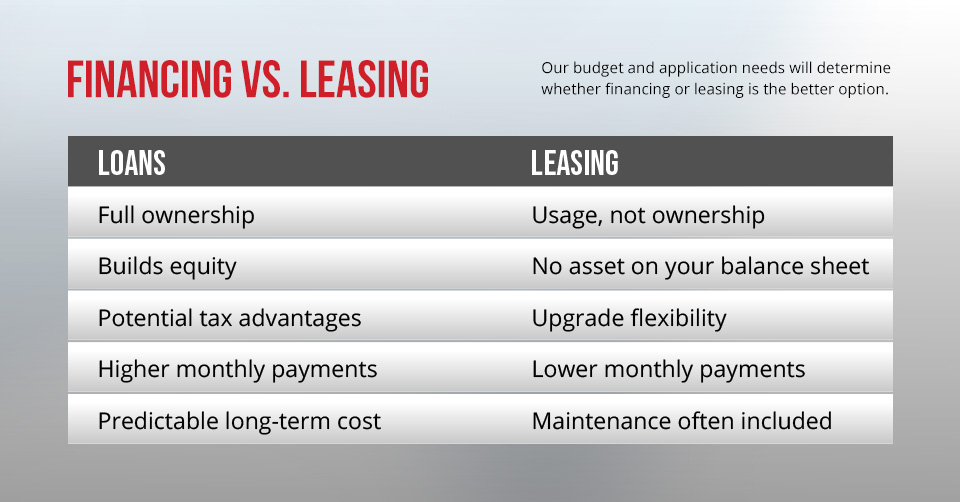
Loans |
Leasing |
|---|---|
| Full ownership | Usage, not ownership |
| Builds equity | No asset on your balance sheet |
| Potential tax advantages | Upgrade flexibility |
| Higher monthly payments | Lower monthly payments |
| Predictable long-term cost | Maintenance often included |
Forklift Loans
Financing through a loan means borrowing money to purchase equipment outright, making regular payments until you own the forklift free and clear.
- Full ownership: Once you complete the loan payments, the equipment belongs entirely to you and becomes an asset on your balance sheet.
- Builds equity: Each payment on your forklift loan increases your ownership stake in the equipment.
- Potential tax advantages: You may be able to lower your taxable income by deducting loan interest and depreciating the equipment over its useful life.
- Higher monthly payments: Paying toward ownership means higher monthly payments than lease fees.
- Predictable long-term cost: Once you’ve satisfied your financing loan, you’ve retired the core acquisition cost. Additionally, lease renewals may bring unexpected terms and fees.
Forklift Leasing
Leasing is a rental agreement in which you pay for the right to use equipment for a specific period without gaining ownership.
- Usage, not ownership: You pay for usage rights but never gain ownership of the forklift.
- Lower monthly payments: Rather than paying the full purchase price, you only pay for depreciation during the lease term, plus interest.
- Maintenance often included: Many lease agreements bundle maintenance and service plans, covering routine servicing and some repairs.
- No asset ownership: Renting means you don’t build equity and the equipment doesn’t appear as an asset on your balance sheet.
- Upgrade flexibility: Forklift leasing lets you rotate into newer, technologically updated models as lease terms end.
Factors to Consider When Deciding to Buy or Lease
When the government evaluates equipment acquisition, it considers a wide range of factors through a thorough case-by-case analysis. Businesses can adopt this process to choose the most advantageous acquisition method.
- Expected usage: How long do you plan to use the equipment? How heavily will it run during that time?
- Total costs: What will be the sum of your payments over the entire period you expect to use it?
- Purchase price: What does the equipment cost after deductions or negotiations?
- Setup and service expenses: What will you incur for delivery, installation and ongoing maintenance?
- Risk of obsolescence: How quickly will technological advancements make the equipment outdated?
Businesses can consider all these factors while weighing tax implications. When you own equipment, you can depreciate its value over its useful life, reducing your taxable income. Additionally, Section 179 of the tax code allows businesses to deduct the full purchase price of new or used equipment in the year they place it in service, rather than depreciating it over several years.
By strategically timing your equipment acquisition, you can lower your tax burden in the same year you put the forklift to work. However, Section 179 has some caveats, including deduction limits. It’s best to consult a tax professional to discuss your specific situation.
Your Forklift Financing Options Explained
Understanding your financing options helps you choose the appropriate path for your business. The following three types differ in ownership structure, payment terms and tax treatment.
1. Capital Lease
A capital lease, or finance lease, is essentially treated like an asset purchase for accounting purposes, even though it’s legally a lease. The leased asset appears on the company’s balance sheet, and both depreciation and interest expenses are recognized. A capital lease works best when you want eventual ownership, plan to use the equipment for most of its useful life and want to leverage depreciation tax benefits.
2. Operating Lease
An operating lease functions as a true rental agreement, with the leasing company retaining ownership. You use the equipment for a set period and return it at the end of the lease term. This suits businesses that prioritize low monthly payments, need flexibility to upgrade to newer technology and only need the equipment for a shorter term.
3. Installment Loan
An installment loan is a type of loan where you borrow a fixed amount of money from a financial institution and repay it over a scheduled period through regular, typically equal, payments. You own the forklift from Day 1. This option fits businesses ready for immediate ownership who plan to use the forklift for its full useful life. These businesses will make higher monthly payments but can leverage depreciation tax advantages.
What Lenders Look for When Financing Used Forklifts
When you apply for forklift finance, lenders evaluate your business to assess creditworthiness and repayment ability. Prepare these documents.
- Employer Identification Number: You’ll need your business’s Employer Identification Number, also known as the Federal Employer Identification Number, to apply for credit.
- Trade references: Ask vendors you’ve established long-term relationships with to provide references vouching for your company’s character.
- Financial history: Lenders want the story of your business’s financial performance over time. They may request bank statements, tax returns and balance sheets.
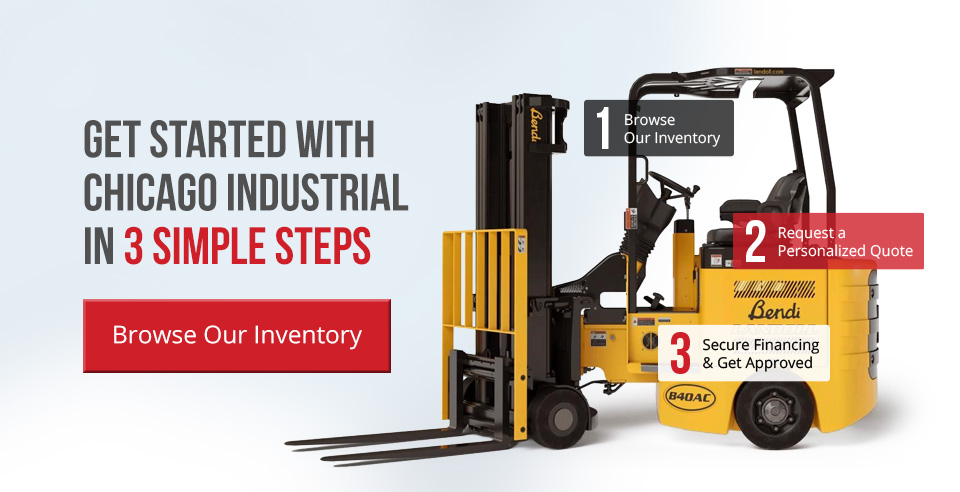
Get Started With Chicago Industrial in 3 Simple Steps
Chicago Industrial operates as the Midwest’s largest dealer of aerial equipment and forklifts, with more than 500 machines available on our 10-acre lot in Rockdale, Ill. We specialize in quality used forklifts that we’ve inspected, serviced and prepared for work.
Beyond equipment, we’ll help you find and finance the perfect forklift for your business. We offer flexible financing options to help you acquire the material handling equipment your operation needs without straining your budget. Browse our complete inventory to see what’s available, fill out our form to request a personalized quote, then obtain financial approval.