
Telescopic vs. Articulating Boom Lift
In 2024, preventable work deaths totaled 4,337, with construction recording the highest number of fatal injuries of any sector. Choosing the wrong aerial lift for a jobsite can contribute to that risk, along with wasted time, repositioning delays and compliance headaches.
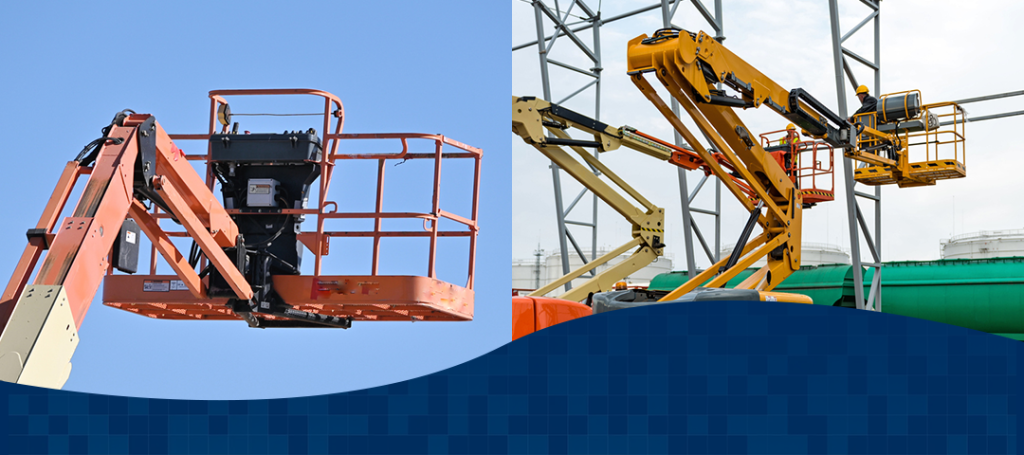
Telescopic boom lifts extend in one direction for the greatest height and horizontal reach. Articulating boom lifts use hinged, jointed segments that bend up and over any obstacles for tighter access. The right choice depends entirely on your jobsite conditions.
This guide breaks down height and reach specs for both boom types, with a side-by-side comparison chart to help you match the right machine to your next project.
Telescopic Boom Lifts
A telescopic boom lift, otherwise known as a straight boom lift, is designed to extend outward in a single direction through nested boom sections, similar to how a telescope expands. This design maximizes horizontal distance and working height on open terrain, making it a strong fit for jobsites without overhead obstructions.
Here’s where a telescopic boom lift fits best:
- Open jobsites: Clear terrain without overhead obstacles lets the boom extend to its full reach without repositioning.
- Maximum horizontal reach: The straight-arm design covers more horizontal distance than a hinged boom of similar height.
- Rough-terrain travel: Many models offer 4WD options built for longer travel over uneven ground.
- Platform capacity: Telescopic lifts often offer higher unrestricted weight capacities, which can be helpful when operators need to bring supplies along.
A few real-world examples illustrate this range. For instance, the Genie telescopic boom lift lineup includes the Genie S-40, which reaches a 46-foot working height with 31 feet of horizontal reach. For jobs that need more height than the Genie S-40, the Genie S-60 extends to a 66-foot working height with 50 feet of horizontal reach.
The JLG telescopic boom lifts include the JLG 1350SJP, offering a 135-foot platform height and 80 feet of horizontal reach.
Articulating Boom Lifts
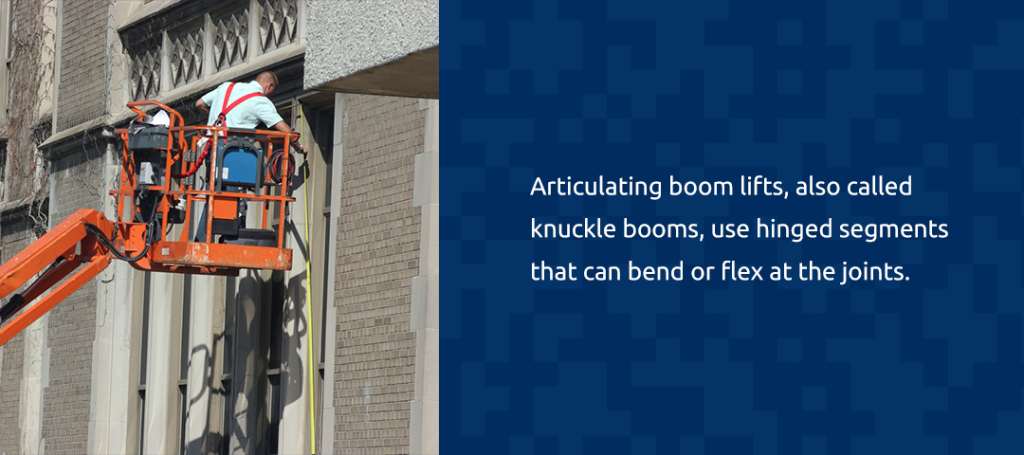
Articulating boom lifts, also called knuckle booms, use hinged segments that can bend or flex at the joints. This lets the platform maneuver around, up and over obstacles instead of extending in a straight line, which is the key mechanical difference from telescopic lifts.
Consider an articulating boom lift for:
- Cluttered jobsites: Beams, pipes and other equipment become easier to navigate around with a jointed boom.
- Confined spaces or obstacles: Trees, buildings and other structures are easier to work around when a lift can bend up and over them.
- Urban or indoor environments: Tight spaces benefit from a smaller turning radius and greater positioning flexibility.
- Jib articulation: A hinged jib section extends the platform’s range of motion well beyond what a straight boom can allow.
The JLG articulating boom lifts include the JLG 800AJ, which reaches an 80-foot platform height with 51 feet of horizontal outreach and a 500-pound platform capacity. On the other hand, Genie articulating boom lifts like the Z-60/37 DC offer a 60-foot platform height with vertical reach for tight indoor and outdoor applications.
For the most restrictive jobsites, the Haulotte articulating boom lifts offer a vertical reach of more than 130 feet on some models.
Side-by-Side Comparison Chart
A boom lift reach chart makes it easy to see the trade-offs between articulating vs. telescoping boom lifts at a glance. You’ll notice telescopic lifts tend to offer greater raw horizontal reach on open terrain, while articulating models trade some reach for up-and-over capability around obstacles.
The boom lift height chart below pulls specs from real models across both categories:
| Model | Type | Max Platform Height | Max Working Height | Horizontal Reach | Platform Capacity |
|---|---|---|---|---|---|
| Genie S-40 | Telescopic | 40 feet | 46 feet | 31 feet | 500 pounds |
| JLG 600S | Telescopic | 60 feet | 66 feet | 50 feet | 500 pounds unrestricted / 1,000 pounds restricted |
| Genie SX-180 | Telescopic | 180 feet | 186 feet | 80 feet | 750 pounds |
| JLG 800AJ | Articulating | 80 feet | 86 feet | 51 feet | 500 pounds |
| Genie Z-60/37 DC | Articulating | 60 feet | 66 feet | 36 feet | 500 pounds |
| Genie ZX-135/70 | Articulating | 135 feet | 141 feet | 69 feet | 600 pounds |
How to Decide Between Telescopic vs. Articulating Boom Lifts
The right lift depends on the worksite and tasks, not which option is universally better. These factors can help settle the decision:
- Obstacles: A clear route to the work area favors a telescopic boom lift for maximum reach, while beams, pipes, building overhangs or machinery in the way favor an articulating boom lift.
- Terrain: Both types offer rough terrain models, but telescopic lifts often handle longer travel distances across open sites more efficiently.
- Height and reach requirements: Extreme height on open ground points toward telescopic, while reaching up and over something points toward articulating.
- Application type: Exterior construction, roofing and open-air infrastructure projects often favor telescopic lifts, while utility work, indoor maintenance and complex urban environments often favor articulating lifts.
If your team has lots of room to work with but requires higher reach, a telescopic boom lift might be the better fit. If a job involves tight spaces or obstacles such as buildings, trees or equipment, an articulating boom lift gives you the flexibility to navigate around them. Strong equipment maintenance and management practices can help your team track which type performs best across multiple jobsites over time.
Safety Tips for Operating Boom Lifts
Between 2011 and 2014, 1,380 workers were injured and 87 died while operating an aerial lift or scissor lift, with slips, trips and falls responsible for roughly half of those fatalities. The following safety practices apply to both telescopic and articulating boom lifts:
- Get certified: Only trained and authorized personnel should operate the boom lift, and certification should cover equipment controls and weight capacities.
- Inspect before every shift: Check fluid levels, tires, hydraulics and safety devices for 10 to 15 minutes before operation begins.
- Assess the worksite: Look for unstable ground, slopes, debris and overhead obstructions before extending the boom.
- Wear fall protection: Secure a harness and lanyard to the designated anchor point in the platform at all times.
- Respect weight limits: Account for the combined weight of operators, tools and materials against the rated load capacity.
- Maintain power line clearance: Keep about 10 feet away from all overhead power lines, treating every line as energized unless verified otherwise.
These practices align with OSHA 29 CFR 1926.453, which governs aerial lift operation in construction settings.
Find the Right Equipment With Chicago Industrial
Terrain, obstacles and height requirements help determine whether a telescopic or articulating boom lift suits your next project. Once you’ve identified the best type for your jobsite, Chicago Industrial Equipment has you covered.
As the Midwest’s largest aerial equipment and forklift dealer, Chicago Industrial Equipment stocks both telescopic and articulating boom lifts from JLG, Genie and Haulotte, with new, used and rental options backed by in-house inspection and financing.
Browse our boom lift inventory to find the ideal fit for your height and reach needs, or contact our equipment specialists if your team needs help choosing between the two.