
New or Used Lift Equipment? A Decision Framework for Fleet and Operations Managers
The global lifting equipment market was valued at $86.96 billion in 2025 and is projected to grow, driven by infrastructure growth and tighter safety standards. Fleet and operations managers feel that pressure directly, with budgets rarely stretching far enough to meet compliance demands. You may be struggling to decide between new and used lift equipment.
New equipment carries a price tag that can be hard to justify. Used equipment promises savings but brings unknowns, like unclear service history, expired warranties and an uncertain remaining lifespan.
A third option exists that few dealers offer — professionally refurbished equipment, inspected and backed by a warranty. This framework walks through the trade-offs, such as depreciation, financing, maintenance and total cost of ownership, to match the right option to your fleet and budget.
New Lift Equipment
New equipment fits a narrower set of operations than most buyers assume, but when it fits, it fits decisively.
Pros
New lift equipment delivers several benefits:
- Predictable early costs: Zero accumulated wear keeps maintenance low through the first several years.
- Manufacturer warranty coverage: New equipment may include a parts-and-labor warranty.
- Current safety standards: New models meet today’s OSHA and ANSI requirements from day one.
- Exact specs and telematics: Order the platform height, attachments and capacity you need, often with built-in tracking.
Cons
New equipment’s trade-offs include:
- High up-front cost: A substantial outlay, often without a clear productivity need.
- Rapid first-year depreciation: A new machine loses a large share of its value in the first year or two. If you plan to resell or trade in, you absorb that drop.
- Longer lead times: Backorders and customization can delay delivery.
Best-Fit Scenarios
New equipment fits best for:
- Indoor, high-frequency work using electric scissor lifts.
- Outdoor projects needing diesel or 4WD rough-terrain booms.
- Telehandlers and high-throughput environments running 8-plus hours a day.
These applications need reliable equipment to meet safety standards from day one.
Used Lift Equipment
Used equipment is a smart choice for the right buyer, offering immediate availability and lower pricing.
Pros
The advantages of used equipment include:
- Lower purchase price: Preowned machinery can cost significantly less, especially when paired with used forklift financing options.
- Reduced depreciation exposure: The original owner has already absorbed the steepest drop in value, so a used asset retains more of its value if you resell it later.
- Faster deployment: Used equipment is often available within days rather than the weeks new equipment can require.
- Operator familiarity: Crews already acclimated to an established model’s controls avoid retraining downtime.
Cons
Used equipment also carries its trade-offs:
- Unknown operating history: You can’t always verify prior use or whether repairs were done correctly.
- Higher maintenance costs: Older hydraulic and powertrain components may fail more often.
- Limited or no warranty: Standard used often comes with a short window or none at all.
- Older technology: Discontinued models can have harder-to-find parts.
Best-Fit Scenarios
Used equipment makes sense when daily usage stays under four hours, or when you need backup units or short-term equipment fast. Before buying, it’s essential to understand your needs and budget. Ask the seller these questions:
- What was it used for, and in what environment?
- What are the total operating hours, and is documentation matched against a maintenance checklist?
- What’s the parts availability, and have there been any major repairs or accidents?
- What warranty, if any, is included?
Refurbished Lift Equipment
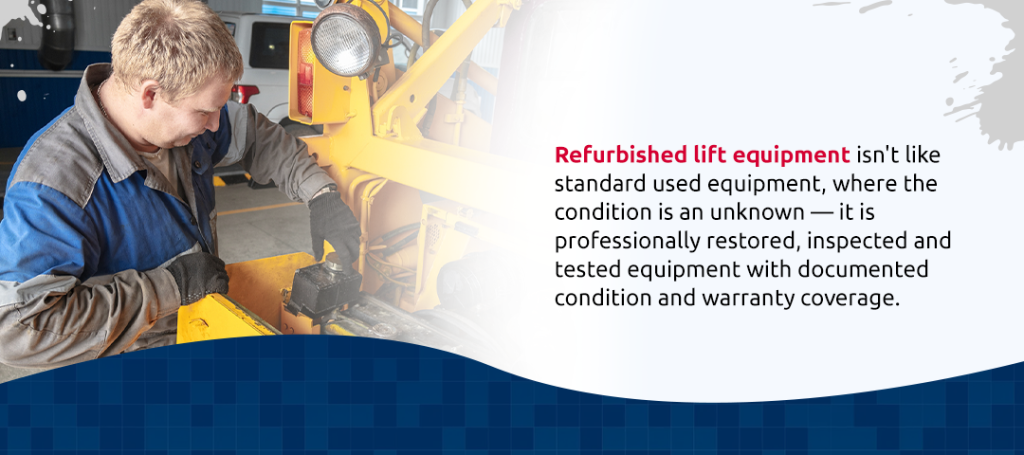
Refurbished lift equipment isn’t like standard used equipment, where the condition is an unknown — it is professionally restored, inspected and tested equipment with documented condition and warranty coverage.
These units move through hands-on inspection and restoration before reaching the lot. Technicians inspect major systems, replace worn components and test performance before any unit goes up for sale.
The value proposition of refurbished lift equipment combines three things:
- Warranty coverage.
- Savings compared to new equipment.
- The known condition standard used can’t match.
Refurbished equipment is best suited to moderate daily use — roughly four to eight hours a day.
How Daily Usage Drives the Decision
Daily operating hours are a reliable variable — often more reliable than age or price. Siemens’ 2024 True Cost of Downtime report estimates that Fortune Global 500 industrial companies lose $1.4 trillion annually to unplanned downtime, equal to about 11% of revenue.
Running eight hours a day, a forklift’s operating threshold arrives after several years of usage — a pace where new equipment’s warranty earns its keep. Here’s a general rule of thumb for buying based on daily equipment usage:
- Under 4 hours a day: Used or refurbished equipment is the practical fit.
- Between 4 and 8 hours a day: Refurbished equipment hits the sweet spot — reliability without new-equipment cost.
- Over 8 hours a day: New equipment’s warranty and reliability become worth the investment.
Equipment-Specific Buying Tips
This buying decision plays out differently depending on the equipment type:
- Forklifts: Operating hours matter more than age when comparing new and used forklifts, and for electric models, battery condition can reduce the savings of buying used.
- Scissor lifts: When comparing used scissor lifts vs. new, platform height and the indoor-versus-outdoor rating matter most.
- Boom lifts: With new boom lift equipment, horizontal reach matters as much as height, and the hydraulic system is the most expensive potential repair on a used unit.
- Telehandlers: Rated load capacity decreases with lift height, so confirm the capacity at your working height and verify attachment compatibility.
What to Inspect Before Buying Used Equipment
Per current OSHA inspection requirements, industrial trucks must be examined before being placed in service. A professional inspection is often worth it, though you can also inspect the machine yourself before finalizing a purchase:
- Visual: Check for cracks or welds on the mast and frame, hydraulic leaks, tire wear and corrosion.
- Operational: Run the machine through its full range of motion and test the horn, lights and emergency lowering systems.
- Documentation: Request service records, confirm operating hours against visible wear and ask about accident history.
Why Choose Chicago Industrial Equipment?
Chicago Industrial is a leading dealer in the region, offering new, used and professionally refurbished lift equipment under one roof. We can walk you through this decision, offering:
- In-house reconditioning: Our own technicians handle every restoration at our Rockdale, Illinois, facility.
- Flexible financing: Our flexible equipment financing options are available on new and used forklifts.
- Nationwide shipping: Our Rockdale showroom ships equipment anywhere in the country.
- Decades in the industry: Chicago Industrial has served fleet and operations managers since 1981.
Choosing the Right Equipment for Your Needs
With the full new vs. used lift equipment picture in view, here’s the short version:
- Choose new if your equipment runs 8-plus hours a day, downtime is mission-critical, or compliance requires current-model safety standards.
- Choose refurbished if you need reliable daily performance at moderate usage, want warranty coverage and want a known condition without new-equipment prices.
- Choose used if your usage stays under 4 hours a day, you need equipment quickly, or you’re sourcing backup units on a tight budget.
Frequently Asked Questions
A few common questions come up once this framework meets a purchase decision.
How much can I save by buying used?
It depends on the model and condition, but the savings can be substantial.
What warranty comes with refurbished?
Our refurbished equipment includes warranty coverage beyond what standard used machinery offers, though exact terms vary by unit. Standard used equipment may carry a short warranty or none at all.
Should I buy from a dealer or a private seller?
For operations managers responsible for worker safety and OSHA compliance, buying from a dealer significantly reduces risk. Documented service history, inspection records and accountability come standard — advantages private sales rarely match.
Can I finance used equipment?
Yes, both new and used equipment can typically be financed, including through our own used equipment financing options.
Contact Chicago Industrial Equipment
Whatever your fleet’s situation, there’s a path that fits it. Chicago Industrial carries new, used and refurbished equipment, inspected and serviced in-house at our Rockdale, Illinois, facility.
Browse our lift inventory to see what’s available now, or contact our team today to talk through your fleet’s specific needs. You can also call us at (815) 744-8811 to speak with someone who knows this equipment inside and out.