
Scissor Lift Safety Guide
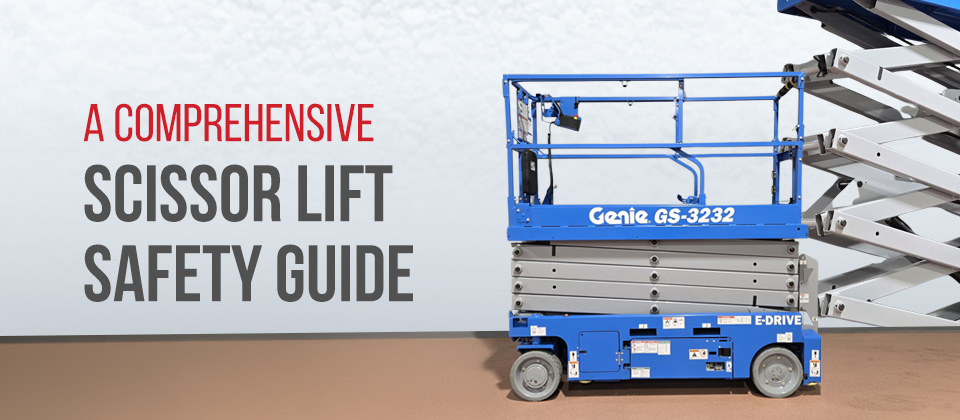
A Comprehensive Scissor Lift Safety Guide
Scissor lifts are versatile pieces of powered access equipment that lift workers and their tools to elevated work areas. Scissor lifts improve efficiency and access in countless work environments, whether workers need to install drywall, clean high windows or manage inventory in high shelving units. Though this equipment is versatile, it can also present serious risks when operators don’t follow procedures.
You can protect your team and maintain compliance by requiring training, conducting daily inspections and adhering to Occupational Safety and Health Administration guidelines. Implementing comprehensive safety protocols will maximize your machinery’s performance while demonstrating your commitment to an accident-free workplace.
The Importance of Safety
According to the 2025 International Powered Access Federation’s Global Safety Report, scissor lifts represent 26% of all fatal and major mobile elevating work platform incidents. A comprehensive safety plan protects employees while reducing accident-related costs.
OSHA can impose significant financial penalties for violations, and a single incident can result in lost productivity, workers’ compensation claims and equipment damage. Conversely, a safe environment boosts productivity and keeps morale high, as protected workers perform better and stay focused on their tasks.
OSHA’s Scissor Lift Safety Principles
OSHA research shows that most scissor lift injuries result when employers don’t address these three critical areas:
- Fall protection
- Stabilization
- Positioning
Employers must evaluate and implement effective controls that address these core safety principles, as each element is responsible for preventing accidents and protecting workers.
Fall Protection
Since IPAF began collecting global accident data in 2012, falls from the platform have consistently been among the top five most frequent incident types involving mobile elevating work platforms. OSHA requires all scissor lifts to have guardrails to prevent falls. Additionally, operators must follow specific protocols to minimize fall risks. They need to:
- Check guardrail conditions before every operation.
- Stand on the lift’s platform, never on the guardrails.
- Avoid leaning over the scissor lift as the work area should be easily accessible.
OSHA specifies detailed requirements for top and midrail specifications. When your guardrail meets these requirements, workers don’t need to wear a personal fall arrest harness on a scissor lift.
Stabilization
Ensuring stable conditions mitigates the risk of tip-overs and collapses. To prevent this machinery from falling over, you need to:
- Work on a firm, level surface away from slopes, debris, bumps and holes.
- Implement traffic control measures to avoid collisions.
- Check wind speeds — scissor lifts rated for outdoor use can generally only handle wind speeds below 28 mph.
Safety officers must also implement appropriate measures to prevent collapses:
- Ensuring all safety features are always in good working order.
- Only using the scissor mechanisms to lift the platform — lifting with other equipment, such as forklifts, is a safety hazard.
- Always remaining under the manufacturer’s load rating.
- Avoiding collisions with other equipment by implementing traffic control measures.
Positioning
Scissor lift hazards include electrocution and entrapment, which occurs when an operator or occupant becomes caught or crushed between the equipment’s controls or platform guardrails and a stationary object or external structure. Employees should be especially vigilant when operating near a fixed object or moving vehicle and when passing a fixed object such as a support beam or door frame.
Workers must have the proper training before operating near live power lines. Even then, they should remain at least 10 feet away from energized power lines and keep the lift isolated with ground guides and traffic control measures.
Scissor Lift Inspection Checklist
Operators should always inspect scissor lifts before every use. Review your owner’s manual — manufacturers often provide detailed inspection lists. Alternatively, you can adapt this comprehensive checklist to your specific machine’s make and model.
- Fluid levels and leaks: Check for oil, fuel, hydraulic fluid or battery fluid leaks. Top off low fluid levels.
- Structural integrity: Inspect for dents, cracks, compromised welds or any other signs of damage to the machine’s structure, chassis and platform.
- Hydraulic system components: Verify hoses, cylinders and connections are in good condition, free from leaks and functioning correctly.
- Electric system components: Inspect battery, cables and connections for damage or corrosion. Ensure all electrical functions are operational.
- Guardrails and gates: All guardrails should be undamaged and securely in place. Gates must work correctly and latch properly.
- Brakes: Test service and parking brakes for proper function and holding capability.
- Emergency stop buttons: Verify that all emergency stop buttons on the platform and ground controls are accessible and functional.
- Operating controls: Test lift, lower, drive and steer controls for smooth and correct operation.
- Platform overload sensing components: Verify that this system is fully functional.
- Mechanical fasteners: Check all bolts, pins and other fasteners for tightness and presence.
- Cables and wiring: Examine all visible cables and electrical wiring for fraying, cuts or damage.
- Tires and wheels: Test tire pressure, look for damage or excessive wear and ensure lug nuts are present and tight.
- Outriggers and stabilizers: Verify that they extend and retract smoothly and are free from damage.
- Loose or missing parts: Conduct a general visual sweep for loose, missing or out-of-place components.
Schedule Routine Maintenance
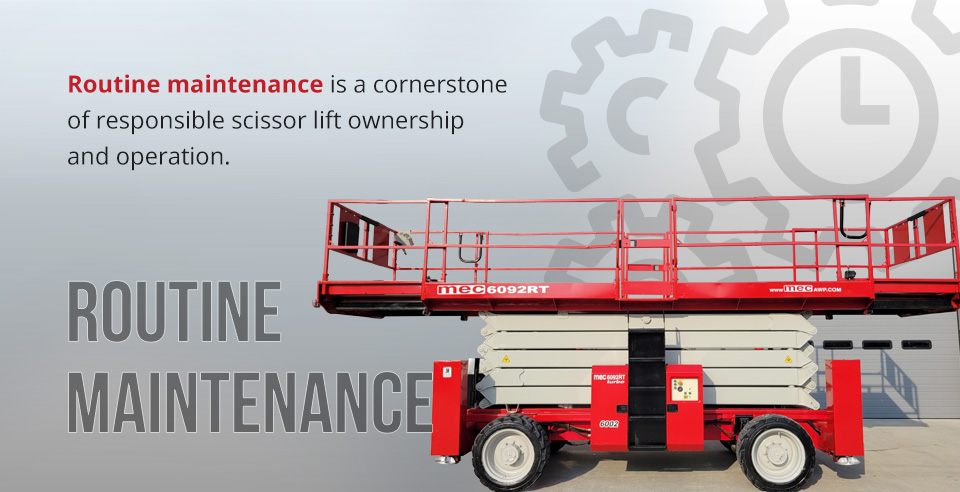
Routine maintenance is a cornerstone of responsible scissor lift ownership and operation. It can reduce downtime, extend your machine’s service life and reduce costly repairs. OSHA requires annual maintenance, but depending on how much you use your scissor lift, you might want to opt for quarterly tuneups.
Only allow qualified personnel to service your scissor lifts and ensure they strictly follow the equipment’s service manual, allowing you to reap the benefits.
Train Your Operators
OSHA requires all scissor lift operators to complete training and earn certification from a qualified instructor. During training, workers should learn to:
- Follow the manufacturer’s specific instructions for vertical operation and moving the scissor lift.
- Understand how to safely manage materials on the lift, especially concerning weight restrictions.
- Identify and mitigate worksite dangers relevant to scissor lift use, such as avoiding electrical wires.
- Swiftly report equipment defects and maintenance needs.
Scissor Lift Safety FAQs
Review our frequently asked questions to learn more about work safety and scissor lift operation.
Do I Need to Wear a Safety Harness When Using a Scissor Lift?
No, not if your scissor lift guardrails meet OSHA standards. However, you will need to wear a harness if you leave the scissor lift platform to complete work at heights.
Can You Drive a Scissor Lift With a Raised Platform?
Check your user’s manual to verify whether it’s safe to drive your scissor lift with the platform elevated, and if so, what the appropriate driving speed is. Always stay under this stated speed limit when operating a raised platform.
Do I Need Certification to Operate a Scissor Lift?
Yes, OSHA requires formal training and certification. You can find a certified training provider through the OSHA education center.
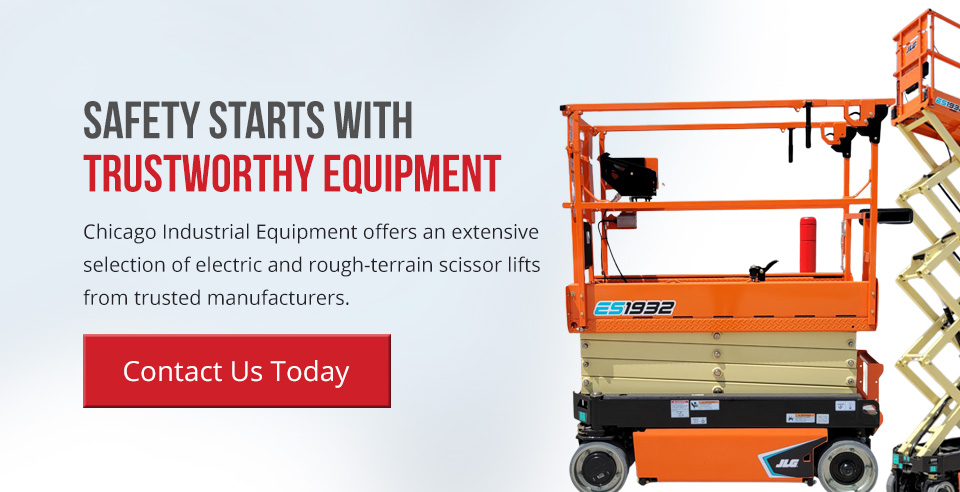
Safety Starts With Trustworthy Equipment
Chicago Industrial Equipment offers an extensive selection of electric and rough-terrain scissor lifts from trusted manufacturers, including Genie and JLG. With over 35 years in the industry, you can trust our team to guide you through the decision-making process, ensuring you get the best machine for your application. Whether you’re expanding your fleet or replacing aging equipment, we can help you find a solution. Contact us to learn more about our inventory.