
The Key Differences Between a Boom Lift and a Scissor Lift
Summary: The main difference between a boom lift and a scissor lift lies in their movement capabilities. Boom lifts can extend both horizontally and vertically, allowing them to reach over obstacles and access heights up to 185 feet. Scissor lifts move only vertically on crisscross supports. However, they generally offer larger platforms and better stability indoors at heights up to 60 feet.
Are you curious about the differences between a boom lift and a scissor lift? Learn the key distinctions and best cases for both.
What Are the Differences Between a Boom Lift and a Scissor Lift?
When you’re planning on completing an aerial project, you might wonder — what’s the difference between a boom lift and a scissor lift, and which one is suitable for your specific job? The answer depends on the nature and environment of the work you need to undertake. Both types of aerial lifts have advantages and drawbacks that make them suited to particular jobs.
When to Use a Boom Lift
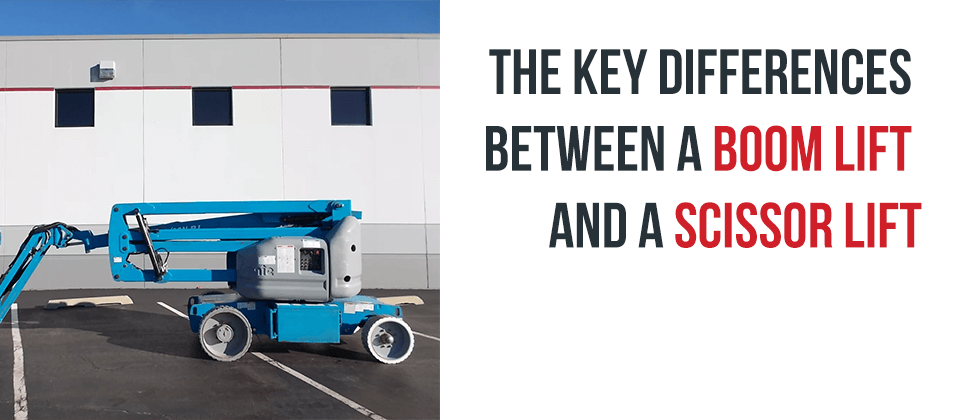
A boom lift — also known as a manlift — features a small platform mounted on a hydraulic arm. The arm maneuvers the platform both horizontally and vertically.
There are two primary kinds of boom lifts — telescopic boom lifts and articulating boom lifts. A telescopic boom lift’s arm features one hinge. On the other hand, an articulating boom lift’s arm has multiple joints, resulting in a better range of motion.
What Is a Boom Lift Used for?
A boom lift makes maneuvering around project obstacles far easier. For example, let’s say you need to access a second-story window, but the ground-floor windows have awnings. A boom lift can dodge the awnings and bring you as close to the second-story window as possible to perform the work.
A boom lift is also excellent for projects at extreme heights. Many boom lifts reach 185 feet, making them ideal for electrical work and construction projects.
When to Use a Scissor Lift
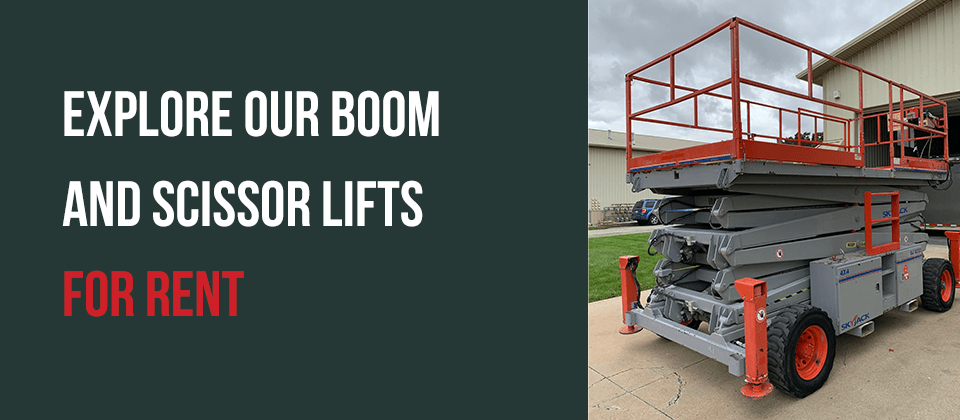
A scissor lift features a platform that maneuvers up and down on a series of crisscrossed support beams. Unlike boom lifts, a scissor lift can only move up and down.
Scissor lift platforms are also larger than boom lift platforms and can support more weight and workers, making them exceptional for projects that require more than one technician. However, scissors lifts don’t extend as high into the air as boom lifts. A scissor lift can reach up to 60 feet or more into the air.
What Is a Scissor Lift Used for?
Scissor lifts suit projects at lower heights in settings such as schools, warehouses and hospitals. They’re also excellent for projects that require multiple workers per platform, including maintenance projects such as painting or window cleaning.
Boom Lift vs. Scissor Lift: What Are the Differences?
While scissor lifts and boom lifts are both aerial platforms, they’re vastly different. The key differences between scissor and boom lifts include:
- Design: Boom lifts feature a small platform situated on a large hydraulic arm. Scissor lifts have a larger platform situated on top of a series of support beams.
- Range: Boom lifts move applications attached to their arms vertically and horizontally and have a diverse range of motion. Scissor lifts only move up and down.
- Height: Boom lifts can reach heights of up to 185 feet, while scissor lifts typically lift personnel up to 60 feet in the air.
- Size: Boom lift arms reach significant heights, but their platforms are smaller. A scissor lift platform is larger and has a heavier load and person capacity.
- Applications: Boom lifts have a more diverse range of applications because they’re easier to maneuver. They’re also compatible with different attachments.
- Cost: Boom lifts tend to be more expensive than scissor lifts due to their complex designs and application capabilities. A scissor lift might be more cost-effective if it suits your needs.
Scissor Lift vs. Boom Lift at a Glance
Here’s how scissor lifts and boom lifts compare:
| Feature | Scissor Lift | Boom Lift |
|---|---|---|
| Maximum height | Up to ~60 feet | Up to ~185 feet |
| Horizontal reach | No horizontal reach (vertical only) | Up to ~80 feet (articulating and telescopic models) |
| Platform size | Larger | Smaller |
| Indoor/outdoor use | Both indoor and outdoor (electric for indoor, diesel for rough terrain outdoors) | Primarily outdoor (electric models are suitable indoors) |
| Terrain capability | Slab models for smooth surfaces, rough terrain models for outdoor sites | 4×4 models handle rough, uneven terrain |
| Best-fit jobs | Warehouse maintenance, painting, window cleaning and projects with multiple workers | Electrical work, construction at extreme heights and maneuvering around obstacles |
Benefits of Renting a Boom or Scissor Lift
There are many benefits to renting an aerial lift as opposed to buying one new, especially if you aren’t sure how often you might need to use it or you need one temporarily. Some of the top benefits of renting a boom or scissor lift include:
1. No Repair or Maintenance Costs

When you own your fleet, you must invest in routine maintenance to prolong its life. You might also need to purchase tools and equipment to perform the maintenance yourself. Plus, you must take on the cost of any repair and technician labor costs associated with the work.
Renting your fleet saves you and your team both time and money in the long term.
2. You Don’t Need to Pay for Storage
In addition to repair and maintenance, you must pay for storage when your fleet isn’t in use. Safe storage prevents weather, rust and theft.
Renting or owning a spot in a storage facility can cost your business a significant sum. This sum can negatively impact your bottom line over time, especially if you aren’t using the equipment often or you own a lot of other large equipment.
However, renting a boom or scissor lift eliminates the cost of storage to help you keep your overhead costs low.
3. You Can Confirm the Equipment Is What You Need
You might have narrowed down whether you need a boom lift or a scissor lift. However, you may not be sure what type of boom or scissor lift is best for the job at hand. By renting a boom or scissor lift, you can “try before you buy” to confirm the aerial lift you choose suits your project and business needs.
Renting also allows you to test out the lift’s performance and whether it’s comfortable for your crew to operate before investing.
4. You Don’t Need to Take out a Loan and Accrue Debt
Boom and scissor lifts are expensive investments. You might need to save up money for years before you can afford to buy outright and own the fleet you need. Large capital investments can also put start-ups and small- to medium-sized businesses at risk.
By renting your fleet, you don’t need to take on any initial debt. Instead, you can save up money as your business grows.
Frequently Asked Questions
Find answers to the most common questions about boom and scissor lifts.
What Is the Main Difference Between a Boom Lift and a Scissor Lift?
The main differences are their design and movement capabilities. A boom lift can reach vertically and horizontally using a hydraulic arm, making it ideal for outdoor environments, extreme heights and reaching over obstacles. A scissor lift moves only up and down, though its large platform supports more weight. Its compact, stable design suits both indoor and outdoor work environments.
Is a Boom Lift or Scissor Lift Safer?
Both boom lifts and scissor lifts are safe when operated correctly. Scissor lifts offer greater stability due to their wider base and vertical-only movement, which reduces the risk of tip-over. However, boom lifts provide safer access to difficult locations. With a boom lift, operators don’t need to reposition the base as frequently.
The safest choice depends on your specific application. Choose the equipment that matches your site conditions and allows operators to work without stretching or overreaching.
Is a Boom Lift or Scissor Lift Better for Warehouses?
Scissor lifts typically perform better in warehouse environments. Their compact footprint allows them to navigate between racks and shelving. Larger platforms mean they can accommodate more workers, tools and materials. Scissor lifts also cause less wear on concrete floors compared to boom lifts.
Boom lifts may be necessary if you need to reach over racking systems in high-ceiling warehouses. However, scissor lifts handle most standard warehouse tasks more efficiently.
What Should I Inspect on a Used Boom Lift?
Here’s what you should inspect on a used boom lift:
- Hydraulic systems: Inspect the hydraulic system for leaks or damage to hoses and cylinders.
- Safety controls: Test the platform controls and emergency lowering system to confirm proper function.
- Structural components: Check all structural welds and joints for cracks, especially on articulating models.
- Tires: Examine the tires or tracks for excessive wear.
- Engine: Verify the engine starts smoothly without any unusual sounds.
Request the boom’s maintenance records. Review its service history to confirm it has been inspected according to manufacturer guidelines. At Chicago Industrial, we inspect and service all equipment in-house before it reaches our showroom.
Explore Our Boom and Scissor Lifts for Rent
When your project requires a heavy-duty, reliable boom or scissor lift, turn to Chicago Industrial Equipment, Inc. We’re a leading provider of state-of-the-art new and used aerial work platforms, including industrial boom lifts and scissor lifts. We also provide flexible financing solutions for industrial equipment to help our customers afford their fleet.
If you’re unsure about which kind of aerial lift is right for the job at hand, contact us today to speak with one of our friendly team members. We have over 39 years of experience in providing top-quality machinery for a diverse range of industrial and construction projects and would be happy to help you find the right equipment type for your needs.
Call 1-815-744-8811 to place an order today!